Friday, May 13, 2011

Fantasy Masterworks #12: Gene Wolfe, Sword and Citadel

The Sword of the Lictor

The Sword of the Lictor, the third volume in Gene Wolfe's The Book of the New Sun series, contains some of the most revealing and troublesome passages in the entire series. In this volume, readers begin to see somewhat clearly for the first time just how deeply layered Severian's adventures are and perhaps the astute reader can begin to sense the strings of narrative manipulation that are occurring both within and outside the written narrative. Since I shall be exploring a few passages and discussing certain events in great detail, it is highly suggested that those who have not yet read this volume refrain from reading it if they value plot details over thematic explorations.

The storyline is again resumed after yet another break in the action. We learn that not only did Severian reach Thrax and assume the office of lictor (the office itself being fraught with religious and civic meanings dating back to the Roman Republic), but that Severian once again abandoned his post and was exiled on account of showing mercy to a female prisoner. As he and Dorcas (for a time, only) flee the city, they have a fierce discussion that ultimately leads to Dorcas's departure. Traveling alone, Severian has many encounters, from the fierce alzabo, from a gland in whose head the magical elixir used in the "diabolic eucharist" of The Claw of the Conciliator is drawn, to the ultimate one with the giant Baldanders that concludes the volume.

While these adventures may provide scenes of amazement and speculation for those reading it for the first time, I want to concentrate on a few lengthy passages from this volume that I believe holds much of importance for interpreting the off-stage events of this series. The first is from the second chapter, as Severian is reflecting upon the innate savagery of humans:

One of the keepers of the Bear Tower once told me that there is no animal so dangerous or so savage and unmanageable as the hybrid resulting when a fighting dog mounts a she-wolf. We are accustomed to think of the beasts of the forest and mountain as wild, and to think of the men who spring up, as it seems, from their soil as savage. But the truth is that there is a wildness more vicious (as we would know better if we were not so habituated to it) in certain domestic animals, despite their understanding so much human speech and sometimes even speaking a few words; and there is a more profound savagery in men and women whose ancestors have lived in cities and towns since the dawn of humanity. Vodalus, in whose veins flowed the undefiled blood of a thousand exultants - exarchs, ethnarchs, and starosts - was capable of violence unimaginable to the autochthons that stalked the streets of Thrax, naked beneath their huanaco cloaks.

Like the dog-wolves (which I never saw, because they were too vicious to be useful), these eclectics took all that was most cruel and ungovernable from their mixed parentage; as friends or followers they were sullen, disloyal, and contentious; as enemies, fierce, deceitful, and vindictive. So at least I had heard from my subordinates at the Vincula, for eclectics made up more than half the prisoners there. 


Man's inhumanity to man. This is one of the oldest forms of conflict, as presented in innumerable literature classrooms across the globe over countless centuries. Homo homini lupus, which Wolfe might have been hinting at in a double entendre form with his talk of the savage dog-wolves. This comment, when viewed in light of Agia's greed and implacable hatred of Severian in the first two volumes as well as the scene of Morwenna's public humiliation and execution in Saltus that opens The Claw of the Conciliator, reinforces the notion that the ancient and exhausted world of Urth is just as full of hatred and pettiness as our own. The fact that it is an executioner making these observations only serves to underscore the irony behind the perhaps-misplaced faith that many have in the upward progression of humans via their own efforts.

Severian's encounter with the two-head Typhon about two-thirds of the way into the novel serves to illustrate a related concept: that of the loss of freedom and the chimera of dominion. Typhon, former ruler of Urth and apparently other world chiliads (or thousands) of years before Severian's time, has been revived somehow by the power of the Claw (Typhon shall also be discussed later outside the New Sun series). He exists as he does due to his appropriation of the slave Piaton's body. This is but the first of many signs in the two short chapters that Typhon appears of the insidiousness of power and its corrupting influence on those who desire to wield it. Typhon, playing the role of the New Testament Satan, tempts Severian with the offer of control of Nessus in exchange for swearing allegiance to him. Severian, although sorely tempted, resists and literally casts out Typhon from the mountain top where the two had their confrontation. Although the religious parallels are obvious and do serve to reinforce many of the religious symbols presented in the earlier book, it is the notion of freedom as opposed to dominion that is central to this scene, as we shall soon see when Severian encounters two other people in his travels after this volume.

Backtracking a bit to the discussion that Severian had with his little namesake (speculation abounds as to if this might be a parallel Severian from another time or even his own son, but I shall not weigh in on this, at least not for now), there is one other scene, rather lengthy, that I want to quote, as it underscores Wolfe's views on freedom and responsibility:

"Severian, who were those men?"

I knew whom he meant. "They were not men, although they were once men and still resemble men. They were zooanthrops, a word that indicates those beasts that are of human shape. Do you understand what I am saying?"

The little boy nodded solemnly, then asked, "Why don't they wear clothes?"

"Because they are no longer human beings, as I told you. A dog is born a dog and a bird is born a bird, but to become a human being is an achievement - you have to think about it. You have been thinking about it for the past three or four years at least, even though you may never have thought about the thinking."

"A dog just looks for things to eat," the boy said.

"Exactly. But that raises the question of whether a person should be forced to do such thinking, and some people decided a long time ago that he should not. We may force a dog, sometimes, to act like a man - to walk on his hind legs and wear a collar and so forth. But we shouldn't and couldn't force a man to act like a man. Did you ever want to fall asleep? When you weren't sleepy or even tired?"

He nodded.

"That was because you wanted to put down the burden of being a boy, at least for a time. Sometimes I drink too much wine, and that is because for a while I would like to stop being a man. Sometimes people take their own lives for that reason. Did you know that?"

"Or they do things that might hurt them," he said. The way he said it told me of arguments overheard; Becan had very probably been that kind of man, or he would not have taken his family to so remote and dangerous a place.

"Yes," I told him. "That can be the same thing. And sometimes certain men, and even women, come to hate the burden of thought, but without loving death. They see the animals and wish to become as they are, answering only to instinct, and not thinking. Do you know what makes you think?"

"My head," the boy said promptly, and grasped it with his hands.

"Animals have heads too - even very stupid animals like crayfish and oxen and ticks. What makes you think is only a small part of your head, inside, just above your eyes." I touched his forehead. "Now if for some reason you wanted one of your hands taken off, there are men you can go to who are skilled in doing that. Suppose, for example, your hand had suffered some hurt from which it would never be well. They could take it away in such a fashion that there would be little chance of any harm coming to the rest of you."

The boy nodded.

"Very well. Those same men can take away that little part of your head that makes you think. They cannot put it back, you understand. And even if they could, you couldn't ask them to do it, once that part was gone. But sometimes people pay these men to take that part away. They want to stop thinking forever, and often they say they wish to turn their backs on all that humanity has done. Then it is no longer just to treat them as human beings - they have become animals, though animals who are still of human shape. You asked why they did not wear clothes. They no longer understand clothes, and so they would not put them on, even if they were very cold, although they might lie down on them or even roll themselves up in them."

Cruelties happen. Harsh dictators like Typhon, only concerned with their well-being and status, occur from time to time in human history. At times, these people and those misfortunes are confronted. But when people abdicate their right to determine their own futures as best as they can, when they deny the common natures of other people and instead treat them in ways that we label as being "inhumane," when people abandon hope in favor for living any which way they live, are they in fact "human?" In this passage, as well as the one already cited above, Wolfe appears to be arguing that no, no they are not "human" in the sense of how people ought to be. These man-animals, the zooanthrops of this volume or the man-apes of Claw, are the products of the self-dehumanization that Wolfe argues that occurs when one has given up their responsibility to be a true human being. This discussion, I believe, sets up the later discussions that Severian will have in Urth of the New Sun. It bears repeating that freedom and self-determination are as much of an undercurrent in this series as are the religious symbols that appear. In fact, one might argue that the two are just two sides of the same coin.


The Citadel of the Autarch

My memories have always appeared with the intensity, almost, of hallucinations, as I have said often in this chronicle. That night I felt I might lose myself forever in them, making of my life a loop instead of a line; and for once I did not resist the temptation but reveled in it. Everything I have described to you came crowding back to me, and a thousand things more.


This quote from the second chapter of the concluding volume to The Book of the New Sun, The Citadel of the Autarch, serves as a foreshadowing of what the reader (as well as Severian, of course) shall experience in the course of the reading. As the series winds to a close, events and people touched upon in the previous volumes return for a time, not to mention that there is a "loop" of an even more literal sense of the word that Severian experiences during the course of this novel. So with this in mind, those who have not yet read this volume may want to wait until they have read it, since there shall be some thematic discussions as well as my first extended look at the character/personalities of Severian himself.

War is hell. It rends, it tears, it shreds its sometimes willing victims apart in ways that go beyond mere physical or emotional trauma. It is a product of two groups of people manipulating others into attempting to destroy one another. It is rather fitting that after the encounter with Typhon in The Sword of the Lictor and Severian's clash with the giant Baldanders (where Severian's sword, Terminus Est, is destroyed), we discover that Severian has gone north to where the forces of the Autarch are battling the Ascian invaders.

Wolfe does not skimp on displaying the horrors of war, having himself been a Korean War veteran. We see not just touching elements such as Severian's discovery of a dead soldier's letter (perhaps intended to hark back to a similar scene in Erich Maria Remarque's classic World War I novel, All Quiet on the Western Front), but also encounter soldiers from both sides of the conflict. While some might make the argument that the Ascian prisoner, Loyal to the Group of Seventeen is little more than a caricature of Cold War era representations of Soviet propagandists being like puppets parroting phrases learned over the course of a lifetime under an inhumane regime, I would counter by noting that this person, who in the story he tells "as translated" demonstrates quite a bit of awareness of the world, albeit shaped in a way that is very difficult for us to fathom. It is as though the worst hints of manipulation that we've seen in the earlier volumes have come to fruition in this rather decent person who cannot speak in more than platitudes that his homeland forced his people to adopt.

But this book is much more than just about the horrors of war. In many senses, this book is devoted to reintroducing characters and showing them in new lights. For example, Severian's old nemesis, Agia, has grown in her time away from Severian. Where earlier she seemed to be devoted solely to her hatred of Severian, her actions and eventual escape from the climatic scene with the wounded Autarch puts her in a Vodalus-like opposition to Severian. It is no longer just a simple personal affair but rather that her opposition has come to symbolize a sort of selfish, "anti-life" rebellion similar to that of Vodalus's against the Autarch, which Wolfe makes explicitly clear in a passage near the end of the book.

We also learn more about Dorcas and her tragic reunion with her now-elderly husband, plus we get further hints in regards to Severian's paternal ancestry. While Dr. Talos and Baldanders do not appear in this volume, there are more than enough hints given that the two represent artifice and its counterfeit nature against the "trueness" that is represented in the Autarchs. And speaking of the Autarchs, or "self-rulers," while much more about their origins is explained in the coda Urth of the New Sun, it becomes quite obvious by the end of the volume that they are the rightful rulers of Urth because they recognize that rule involves much more than just dominion over another. It involves a self-sacrifice and a heavy burden of sacrifice and commitment to the needs of others. It is for this reason, Severian reminisces, that the Autarchs have not been descended from a prior Autarch but have come from people of human origin who usually are not the greatest in any of their fields. After all, pride is an insidious thing that can emerge from the glories of greatness and greatness often is antithetical to being truly concerned with the rights of all.

And so over the course of these four volumes, the reader has encountered many base and treacherous characters. From greed and the thirst for dominion over others, we have seen people such as Vodalus, Agia, and Typhon lust. There is no love involved in their quests for power and, in Typhon's case, immortality. We have also sensed that behind this lurks the nihilistic impulses of Abaia and Erebus, those aptly-named beings who symbolize the darkness and coldness which threaten not just the physical Urth but also the spiritual well-being of its inhabitants. We have witnessed the results in the persons of the Ascians, as Severian so eloquently notes in this passage:

These Ascian soldiers had a rigity, a will-less attachment to order, that I have never seen elsewhere, and that appeared to me to have no roots in either spirit or discipline as I understand them. They seemed to obey because they could not conceive of any other course of action.
But opposed to these horrors is a sense of responsibility and of duty to be just and to love what can be loved among the peoples and creatures of Urth. Much has been made about the calls for the New Sun over the course of the novels (and much more of this in Urth of the New Sun), but in the scene where the last Autarch passes along his responsibilities to Severian, there is a passage that sums up quite well the good/evil conflict that has occurred:

"You were right to hate me, Severian. I stand...as you will stand...for so much that is wrong."

"Why?" I asked. "Why?" I was on my knees beside him.

"Because all else is worse. Until the New Sun comes, we have but a choice of evils. All have been tried, and all have failed. Goods in common, the rule of the people...everything. You wish for progress? The Ascians have it. They are deafened by it, crazed by the death of Nature till they are ready to accept Erebus and the rest as gods. We hold humankind stationary...in barbarism. The Autarch protects the people from the exultants, and the exultants...shelter them from the Autarch. The religious comfort them. We have closed the roads to paralyze the social order..."

His eyes fell shut. I put my hand upon his chest to feel the faint stirring of his heart.

"Until the New Sun..."

This was what I had sought to escape, not Agia or Vodalus or the Ascians. As gently as I could, I lifted the chain from his neck, unstoppered the vial and swallowed the drug. Then with that short, stiff blade I did what had to be done.
There are no clear-cut decisions to be made; only a choice of evils. Urth is an imperfect world and each choice is fraught with evil possibilities or consequences. In such a world, it is hard to hold hope, Wolfe seems to be arguing, but yet, somehow, people have managed to do so. Until the New Sun. A phrase laden with symbolic meanings of rebirth and renewal. A phrase that hints at the washing away of the old creation in ways akin to the language of Revelations. And who is to bring this New Sun?

No other than Severian. A Torturer who shows mercy in spite of the strictures placed on him. A self-deceiving and not always likable person who has undergone so many changes during the course of his travels. A person who finds a holy relic, only at the end to learn this:

At that time I did not think of it, being filled with wonder - but may it not be that we were guided to the unfinished Sand Garden? I carried the Claw even then, though I did not know it; Agia had already slipped it under the closure of my sabretache. Might it not be that we came to the unfinished garden so that the Claw, flying as it were against the wind of Time, might make its farewell? The idea is absurd. But then, all ideas are absurd.

What struck me on the beach and it struck me indeed, so that I staggered as at a blow - was that if the Eternal Principle had rested in that curbed thorn I had carried about my neck across so many leagues, and if it now rested in the new thorn (perhaps the same thorn) I had only now put there, then it might rest in anything, and in fact probably did rest in everything, in every thorn on every bush, in every drop of water in the sea. The thorn was a sacred Claw because all thorns were sacred Claws; the sand in my boots was sacred sand because it came from a beach of sacred sand. The cenobites treasured up the relics of the sannyasins because the sannyasins had approached the Pancreator. But everything had approached and even touched the Pancreator, because everything had dropped from his hand. Everything was a relic. All the world was a relic. I drew off my boots, that had traveled with me so far, and threw them into the waves that I might not walk shod on holy ground.
We have come full-circle; the symbols that shaped Severian's journey have mostly been unraveled. We create relics, Wolfe appears to argue, because we need them to remind us of the Increate/Pancreator. We need material things to remind us of the spiritual, for which we ever seem to be grasping. Severian is not a perfect man, but he has sought to relieve himself of his impurities. He has been through the fires of temptation, especially with Typhon, but now he is changed. He is not a Christ, but he certainly has become the ideal of a Christian, some might argue based on Wolfe's liberal sprinkling of Christian symbols throughout the narrative.

And that rose carved into that tombstone? It is a symbol for Catholics and Eastern Orthodox for the Virgin Mary and also for Christ. The fountain? It is the well-spring of the Water of Life, or of the Christ of St. John 7. The spaceship? It symbolizes the next step in Severian's life.

And the tomb itself? It is empty. Not the way that Christ's tomb is empty, but empty nonetheless due to the matter of time (which is addressed in  Urth of the New Sun).  Hopefully these reviews have encouraged people to re-read and to re-consider this masterpiece of literature. I know I did not touch upon everything and that some of my interpretations certainly can be challenged. Nonetheless, a work like this deserves nothing less than honest people arguing over matters of interpretation, no?  

Fantasy Masterworks #1: Gene Wolfe, Shadow and Claw

The four-volume The Book of the New Sun is widely considered to be Gene Wolfe's magnus opus and it consistently ranks as one of the most highly-regarded literary works of the past 30 years. Blending elements of science-fiction and fantasy into a first-person narrative, these four volumes (The Shadow of the Torturer (1980); The Claw of the Conciliator (1981); The Sword of the Lictor (1981); and The Citadel of the Autarch (1982)) have won or been nominated for multiple World Fantasy and Nebula Awards. Filled with allusions to creation myths, Christianity, hagiography, the Cold War, etc., these books have provided fodder for all sorts of speculation as to what lay underneath the surface of the narrative.


The Shadow of the Torturer

The epigraph to this book holds an important clue towards one of the themes of this series, that of religious parousia (or the Second Coming) and eschatology (or the belief in the "end times" of the world as we know it):

A thousand ages, in thy sight, are like an evening gone; short as the watch that ends the night, before the rising sun.
Taken from the fourth stanza of Isaac Watts's famous hymn, "O God, Our Help in Ages Past," this epigraph highlights the religious imagery and metaphors that will appear repeatedly during the course of these four volumes, albeit many of these religious symbols will be kept to the background and the reader can enjoy the story without needing to be well-versed in Christian (and especially Catholic) theology and traditions.

The story itself begins near the end of the narrative timeline. The main character, Severian, has just finished recording a narrative of his adventures that led him from being an apprentice (later journeyman) of the ancient guild of the Seekers for Truth and Penitence, more commonly known as the Torturers. Severian, who tells this tale in first-person PoV, claims to have an eidetic, or "perfect," memory. As he narrates his life from growing up as an orphan among the Torturers to his coming of age, he reveals in passing certain discoveries that will later play a role near the end of the series. Among these is his playing in the necropolis of the ancient city of Nessus and his discovery of a tomb that has etched upon it the likenesses of a rose, a fountain, and a spaceship. These shall be discussed later.

However, there is a scene at the end of the first chapter where the boy Severian receives a coin from the rebel Vodalus. Severian makes an interesting observation that will bear heavily upon the importance of the events that follow:

We believe that we invent symbols. The truth is that they invent us; we are their creatures, shaped by their hard, defining edges. When soldiers take their oath they are given a coin, an asimi stamped with the profile of the Autarch. Their acceptance of that coin is their acceptance of the special duties and burdens of military life - they are soldiers from that moment, though they may know nothing of the management of arms. I did not know that then, but it is a profound mistake to believe that we must know of such things to be influenced by them, and in fact to believe so is to believe in the most debased and superstitious kind of magic. The would-be sorcerer alone has faith in the efficacy of pure knowledge; rational people know that things act of themselves or not at all.
It is this self-defining of ourselves, of our surroundings, and of our "purposes" and how each affects the characters' interactions with each other and their surroundings that drives much of the action that occurs. From Severian's later acquisition of a religious relic, the legendary Claw of the Conciliator (who in presented as being an analogue to Christ although not in a direct one-to-one correlation), to how others refer to the blasted and diseased red sun of ancient Urth and the belief that one day that the Conciliator would "return" to bring a "New Sun" (literal, metaphorical, or both depending upon the person), this notion that we are defined by the symbols we choose to represent our hopes and fears is one that Wolfe returns to on multiple occasions in the course of the series.

One such example of this symbolic interplay is that of Katharine (St. Catherine of Alexandria), who is the patroness of the Torturers. From the slightly altered re-enactment of her martyrdom to the quite ironic adoption of her as being the patroness of the Torturers, the symbolic execution and the expression of faith done through such a re-enactment serve to underscore Severian's later betrayal of his guild via the forbidden showing of mercy to an exultant (high-born, genetically altered nobility on Urth) lady, the Chatelaine Thecla. It is this "betrayal," perhaps akin to some degree with the scene of Jesus and the adulteress in the Gospels, that leads to a journey of exile for Severian.

During this exile/assignation to the city of Thrax, where Severian is to be the Lictor (or executioner) in lieu of being held in hopes of a death sentence, Severian meets up with many characters, from the vengeful Agia to the monstrous Baldanders and his companion Dr. Taltos to many others. One of the more mysterious characters is that of Dorcas, who lives up to her namesake when somehow she is "revived" when Severian finds himself diving into a pond to retrieve his sword Terminus Est (more on that shortly). The latter volumes hints not just at the healing powers of the Claw of the Conciliator, but also at the tangled skein of Severian's own personal past.

When Severian was presented with the executioner's sword Terminus Est, the presentation of its meanings (line of division, this is the end) illustrates Severian's role. Not only is he the executioner of those sentenced to die, not only is he the final image of authority that the condemned see before they die, but the name itself refers to the old Roman god Terminus, the lord of boundaries. In this case, the boundary between life and death and their interrelationships with each other are symbolized with how Severian uses the sword during the course of his travels.

While I certainly could continue to narrate various symbolic actions during the course of this first volume, I want to focus instead on a discussion Severian has near the end of this book with the apparent shade/ghost/image of one of his former Masters, Malrubius:

"Severian. Name for me the seven principles of goverance."

It was an effort for me to speak, but I managed (in my dream, if it was a dream) to say, "I do not recall that we have studied such a thing, Master."

"You were always the most careless of my boys," he told me, and fell silent.

A foreboding grew on me; I sensed that if I did not reply, some tragedy would occur. At last I began weakly, "Anarchy..."

"That is not governance, but the lack of it. I taught you that it precedes all governance. Now list the seven sorts."

"Attachment to the person of the monarch. Attachment to a bloodline or other sequence of succession. Attachment to the royal state. Attachment to a code legitimizing the governing state. Attachment to the law only. Attachment to a greater or lesser board of electors, as framers of the law. Attachment to an abstraction conceived as including the body of electors, other bodies giving rise to them, and numerous other elements, largely ideal."

"Tolerable. Of these, which is the earliest form, and which the highest?"

"The development is in the order given, Master," I said. "But I do not recall that you ever asked before which was highest."

Master Malrubius leaned forward, his eyes burning brighter than the coals of the fire. "Which is highest, Severian?"

"The last, Master?"

"You mean attachment to an abstraction conceived as including the body of electors, other bodies giving rise to them, and numerous other elements, largely ideal?"

"Yes, Master."

"Of what kind, Severian, is your own attachment to the Divine Entity?"

I said nothing. It may have been that I was thinking; but if so, my mind was much too filled with sleep to be conscious of its thought. Instead, I became profoundly aware of my physical surroundings. The sky above my face in all its grandeur seemed to have been made solely for my benefit, and to be presented for my inspection now. I lay upon the ground as upon a woman, and the very air that surrounded me seemed a thing as admirable as crystal and as fluid as wine.

"Answer me, Severian."

"The first, if I have any."

"To the person of the monarch?"

"Yes, because there is no succession."

"The animal that rests beside you now would die for you. Of what kind is his attachment to you?"

"The first?"

There was no one there. I sat up. Malrubius and Triskele had vanished, yet my side felt faintly warm.

This scene reveals quite a bit, not just about how Severian orders his priorities in accordance to a hierarchy of legal standards, but more about how this attachment to the Divine in the personal form not only foreshadows what occurs later, but also how it symbolizes the views that the religious have in regards to matters of faith. This concept of ordering the power relationships not only refers back to the medieval Great Chain of Being, but it can also symbolize yet again the passage that I quoted at the beginning of this post.

The Claw of the Conciliator

Thecla, the Chateleine who once was was the Autarch's leman (in this specific example, quasi lover, as we shall see later in this volume) before being seized and brought to the Torturers because of certain papers that implicated her as being associated with Vodalus, is in many senses the half-overlooked center of this series. We only learn the basics about her torture and how the diabolical Revolutionary drove away her will to live. I did not note it in the first review, but one could make an argument that the Revolutionary serves to represent our tendency to find faults in ourselves, often to the point of us committing what many Christians might call the most insidious of the Seven Deadly Sins, that of sloth/despair. In the course of the narrative, Severian stops at the point of exploring just what were the exact effects of the Revolutionary, but based on his passing comments, the hypothesis that I presented above might be developed from it.

Thecla's personality, which later we learn is often petty and cruel, is important not so much because we "witnessed" her torture and suicide, but because of a recurrent theme in this volume, one that was hinted at earlier with Dorcas's rising from the pond: resurrection of the body. A great many of the events that occur in this volume revolve in some point around the resurrection of the body or soul, or conversely, around the decay and corruption of both body and mind.

Jonas, a companion from afar who joins Severian near the end of the first volume, is one such example. Wounded in an attack about two-thirds into this volume, Jonas's body of cells and metal represents a sort of a reverse cyborg; a machine clothing itself in human parts in order to repair some prior damage. Severian's attempts to "heal" Jonas are only partial, but this melding of the biological with the mechanical in the person of Jonas perhaps could be viewed as a metaphor for the interactions between the physical body and the spiritual soul. However, the text is ambiguous on this point and I do not have citations to present to support this point.

Jolenta, the Nessus barmaid who becomes part of Dr. Taltos and Baldanders's travelling troupe, serves as an example of this mind/body union. Altered by Dr. Taltos's arts, she has become a thing of beauty and of desire, but yet there is a sickness within that mutates from a metaphorical matter into a very real and visible disorder near the end of the book. Her façade has crumbled and what we see then is now related to what the astute reader might have perceived soon after the first encounter with her after her transformation.

Dr. Talos, that mad scientist whose skills have managed to create simulacra of life, beauty, and truth. The composer of that play near the end which serves to foreshadow the concluding two volumes of Severian's saga. The fox-like creature, so clever and so manipulative, the apparent source of so much subterfuge. I have read elsewhere that some have postulated that Talos is based on the mythological Cretan creature of bronze that guarded the island, while others have noted his role as artificer as being but an extension of this attempt to replicate life via mechanical means. I side more with this second explanation, as Talos (and by extension, Baldanders) seem at first to have goals so similar to the more mystical bringing of the New Sun (or the second blooming of life on Urth), but whose means betray their real end goals.

By now, perhaps you are weary of my digressions and wondering just why I haven't discussed the plot of The Claw of the Conciliator. While it may seem as though I have digressed and not have attempted to explore the "story" of this novel and its strengths and weaknesses, in many ways I have covered just that, albeit via those seeming detours of character study. While The Claw of the Conciliator certain can be read on the surface level as the continued travels of Severian and friends from the gates of Nessus to the outliers of Thrax, to understand why the multitude of events such as Severian's second meeting with Vodalus and what transpired there occurred the way they did means adopting some of Severian's own approaches towards telling his story.

There were quite a few lacunae in this tale. Not only does the opening chapter pick up on the other side of those colossal gates of Nessus, in the town of Saltus (some commentators have noted that since the action apparently is set in South America, that Nessus may be the corruption of Buenos Aires and Saltus may be the alteration of the Argentine province/town of Salta), but the tone of the narrative changes. The careful reader has already noted, doubtless, that while Severian's eidetic memory has left him sharing all sorts of petty little details such as the stories from the brown book from Ultan's library in Nessus that he took after Thecla's suicide and his banishment to Thrax, there is so much that he is skipping or deigning to downplay. The open lies and lies by omission that will later become a hallmark of Severian's character are more on display here.

Also, the scene about halfway into the novel where Vodalus and his associates invite Severian to partake in what Wolfe later called a "diabolical eucharist" of consuming Thecla's body while drinking an elixir from an alien creature known as the alzabo (more on that in the next volume) is a turning point in the narrative. Lies of omission or not, the Severian "voice" that we have encountered to date appears to be singular in nature, but slowly after this scene, the thoughts and personality of the consumed Thecla emerge and occasionally the "Severian" we encounter on the pages of the book is somehow different; sometimes Thecla in tone, sometimes Severian, other times an amalgamation of the two. This partaking of the body and receiving something of the mind/spirit of the deceased is a sort of a perversion, some might say, of the Catholic/Orthodox doctrine of the Real Presence of the Christ in the wine and bread consumed in the Eucharist. It certainly something whose ramifications will become more evident in the succeeding volumes.

As I said earlier, resurrection motifs abound in this volume. From the healing of the man-apes (how did those creatures evolve or perhaps devolve over time?) to the partial healing of Jonas to the nigh-useless attempt on Jolenta, the blue gem that Severian carries, the legendary Claw of the Conciliator, serves to highlight this theme of healing in the midst of death and suffering. While I will address the theme of suffering later in the review of the second omnibus, it bears to keep this matter in mind as one reads these volumes.

The allusion-filled play near the end that Severian, Dorcas, Jolenta, Dr. Talos, and Baldanders perform (before I forget, there are a couple of scenes that I'm purposely leaving out as I need to wait until the fourth volume to discuss them at length) serves to foreshadow what lies underneath the journey of the exiled journeyman Torturer. From the Persian names for Adam and Eve to the mention of the "dawn" of Ushas (herself a Hindu deity of the dawn), the eschatological interpretation of the New Sun is presented in a way that seems opaque at first, but which yields so much fruit once the series is complete. Since I am writing this review with those who have just finished reading Shadow and Claw for the first time, I will pause here. After all, the road again is not an easy one to travel.  

Sunday, April 3, 2011

Fantasy Masterworks #4: Jack Vance, Tales of the Dying Earth

"In ages gone," the Sage had said, his eyes fixed on a low star, "a thousand spells were known to sorcery and the wizards effected their wills. Today, as Earth dies, a hundred spells remain to man's knowledge, and these have come to us through the ancient books...But there is one called Pandelume, who knows all the spells, all the incantations, cantraps, runes, and thaumaturgies that have ever wrenched and molded space..." He had fallen silent, lost in his thoughts. (p. 4)
There is something powerful about a ruin. Seeing grandeur cast down, witnessing the failing of a majestic vision, viewing a ruin inspires in many a mixture of wonder and contempt. Who could have created such majestic structures so long ago? What sort of folly befell this civilization for only broken, ivy-covered remnants remaining to serve notice of that culture's collapse? Does such a fate await our own?

Jack Vance in the four stories collected in his Tales from the Dying Earth takes these questions and fast-forwards things millions of years into the Earth's future, to a time in which the Earth's resources have been exhausted and its inhabitants live among the ruins of civilizations about which they know less than we do of the ancient Egyptians or Chinese. For them, Arthur C. Clarke's adage about advanced technology being scarcely distinguishable from magic in the eyes of those who cannot comprehend the technology being employed holds true.

The four stories in this omnibus, The Dying Earth (1950), The Eyes of the Overworld (1966), Cugel's Saga (1983), and Rhialto the Marvellous (1984), share little in common with one another except the same far-future setting and in the case of the middle two volumes, the protagonist called Cugel. While I knew going in that these stories were best viewed as being separate tales that perhaps ought to be considered separately, as a whole I found myself struggling at times with the stories.

I've had this omnibus for almost five years now, but I never could get beyond the first pages of The Eyes of the Overworld before putting it down in favor of another book. The first volume's rather dated narrative approach (it feels like an odd inversion of the action/adventure stories in the stamp of an Edgar Rice Burroughs in its exotic-yet-somehow-familiar setting and the 1930s-style matinee adventure hero) was trying enough, despite at times Vance's prose rising above that rather pedestrian level. But there was something about Cugel at the time that just irritated me. While on this most recent read, where I sat down one afternoon and just forced myself to keep reading despite my attention waning at times, Cugel's banter seemed more palatable, it wasn't until the very end of The Eyes of the Overworld that I began to warm to Cugel's rakish charm.

Cugel's Saga, however, dashed that charitable feeling. At nearly 300 pages, it was by far the longest of the four tales, and I just felt as though the story dragged the entire time. While there were occasional sharp, witty exchanges between Cugel and those around him, on the whole the story just felt lifeless to me, as if it were just one more foray for Cugel, one more time into the breach, but with nothing of import to show for it. By the time I reached the final tale, Rhialto the Marvellous, I just was eager to finish the damn thing. In the end, I think I made the worse decision by pushing on, leaving me to write something that was more akin to a confession that this tale didn't work for me and that at least part of the problem lay with my own past problems with a few elements early in the omnibus.

Will I try again in the future? Perhaps, since I hate the fact that I disengaged myself from processing this book about halfway through and that there is that suspicion that if I had tried just a bit harder, I could have wrung something from it other than the feeling that this collection was rather disjointed and that dying earth stories have been done better by those who followed Vance than by Vance himself. However, it'll be some time (likely a couple of years at least), but if I do try again, I'll at least try to accentuate the positive more than I did here.  Certainly not the "masterwork" in terms of prose or characterization that his other Masterworks titles, the Lyonesse and Emphyrio titles, prove to be.

Tuesday, March 29, 2011

Fantasy Masterworks #32: Poul Anderson, The Broken Sword

"The world is flesh dissolving off a dead skull," mumbled the troll-woman. She clanked her chain and lay back, shuddering. "Birth is but the breeding of maggots in the crumbling flesh. Already the skull's teeth leer forth, and black crows have left its eye-sockets empty. Soon a barren wind will blow through its bare white bones." She howled as Imric closed the door. "He is waiting for me, he is waiting on the hill where the mist blows ragged on the wind, for nine hundred years has he waited. The black cock crows - "

Imric locked the door anew and hastened up the stairs. He had no liking for making changelings, but the chance of getting a human baby was too rare to lose. (p. 13)
Although I had heard of Poul Anderson and had seen his second novel, The Broken Sword (1954), praised by authors such as Michael Moorcock, I never got around to buying a copy of this book until a few weeks ago, after I read Richard Morgan's Suvudu article on his problems with J.R.R. Tolkien. In the furor that emerged there and on various blogs and forums, Morgan mentioned Anderson as an author who wrote a more "authentic" [my word for what Morgan was describing, although he might have used it in one of the numerous exchanges last month] fantasy that did not provide a cop-out, consolatory ending, but instead was the other Norse-influenced fantasy novel of 1954 that kept most of those sagas' Götterdämmerung elements in the narrative. Curious to know if Morgan's high praise of Anderson was merited, I imported a copy of the Gollancz Fantasy Masterworks edition of The Broken Sword to see what my initial impressions would be.

When I wrote my reflective essays on Tolkien, I kept referring back to the occasional problems that I would have with Tolkien's prose, or rather with the opaqueness that often would occur when Tolkien would shift to a more archaic, formal narrative voice. I found that this, combined with said language often being tied in to Tolkien's introduction of his invented historical events to the narrative, to be a distraction that detracted from the "present" story. Anderson also utilizes a narrative voice that resembles that of the old Norse sagas. However, this prose style enhances the story rather than weakening it, due to Anderson's story being set in a slightly-fantasized England of the earliest Norse sagas of the 8th and 9th centuries CE.

The quote at the beginning of this essay illustrates how well Anderson uses this literary mode. The elf lord, Imric, seeks to have a changeling replace the newborn human child of Orm the Strong, Valgard, as humans fostered in the elvish Alfheim are of great use against the elves' primary enemies, the trolls. But instead of spelling it out in laborious detail, as might be expected if Anderson had used contemporary prose styles, his use of a quasi-epic poetic style forces the reader to consider the import of each word. In the passage quoted above, the changeling Valgard is the product of a cruel rape. The troll mother's hate-filled lament takes on the form of a prophecy, with death's skull and suffering's barren wind conjuring images of devastation without any hope of redress.

This passage and a later one introducing the titular broken sword presage fell and horrific tragedies to follow. Just as many of the Norse sagas contained horrific weirds and mass slaughtering, so too does Anderson's take on this ancient narrative form. The stolen child, renamed Skafloc, and his changeling double, Valgard, have intertwined fates that involve each losing everything near and dear to them. Anderson is unrelenting with their characters, showing each to be pawns in greater games being played by the old gods against the growing menance of the White Christ, whose cross is the bane of elf, troll, and god alike, as well as them being tools of the elves and trolls in their immemorial battles for supremacy over the other. While at times these two characters come perilously close to being cardboard cutouts of dynamic, conflicted characters, for the most part I found myself caught up in their personality differences. Each is the mirror of the other. If Valgard be sullen and quick to enter the bezerker rage, Skafloc is a smooth, seductive operator. If Skafloc be comfortable with his role as Imric's foster human child, Valgard never manages to fit in with Orm's other children. Anderson masterfully uses their disparate character traits to drive the plot towards its damning, bloody end.

The broken sword itself is an intriguing plot element. A mysterious gift to Imric, its fell destiny as being the accursed weapon that Skafloc is fated to use to tragic effect stands out in comparison to Tolkien's Ring. Both are "evil" artifacts, but whereas Tolkien's Ring could be seen as a metaphor for the glamors cast by temptation, Anderson's sword, later forged anew, can be viewed as being a representation of fate and of the tragic suffering that humans will endure, whether it be at the hands of gods, chance, or humans themselves. Take for instance this passage after Valgard discovers his true origins:

"I am strong," he growled, deep in his throat. "When I was a viking, I broke men with my bare hands. And I have no fear in battle, and I am cunning. Many victories have I won, and I will win many more."

His hands fell slackly to his lap and his eyes darkened with horror. "But what of that?" he whispered. "What of that? Why am I so? Because Imric made me thus. He molded me into the image of Orm's son. I am alive for no other reason, and all my strength and looks and brain are - Skafloc's!"

He stumbled to his feet. Blindly he stared before him, and his voice rose to a scream: "What am I but the shadow of Skafloc?" (p. 241)
Here Valgard takes on the role of the accursed victim of fate, one doomed to kill those around him. It is a bleak, tragic life, one that is portrayed in turns as being sympathetic and loathsome. I found myself drawn to this solitary character, reminded of another Tolkien character, that of Túrin. But whereas Tolkien's Túrin finds momentary pleasures that simultaneously lessen and increase the magnitude of his black fate, Anderson's Valgard has no moments of cheer, no hopes of love, nothing but an almost nihilistic desire to have all symbols of his past erased by fire and his axe. Skafloc, however, with his fated encounter with Freda, balances Valgard's unrelenting darkness by his gradual fall from a diffident playboy type to a suffering, love-stricken fool whose love proves to be another example of fate's capricious cruelty. As a tragedy, The Broken Sword is one of the earliest (and best) produced in fantasy literature.

The conclusion to The Broken Sword fulfills the promise of the earlier plot revelations and of the characters' intertwined, mirrored personalities. As rage and suffering builds throughout the final third of this 274 page novel, the narrative becomes more taut, as the plot tension is distilled into short, terse paragraphs that pack a strong punch. The formerly-broken sword's trecherousness is revealed and the Skafloc/Valgard duo discover this in ways true to their characters. There is no sense of "closure," only that their tragic tale is but one small part in a greater, unfolding tragedy that is destined to spill out into all the realms at some indeterminate date.

Although I worried that reading The Broken Sword less than a week after finishing The Lord of the Rings might lessen the effect on me, I found the opposite to be true. I can see why critics of The Lord of the Rings (the story of The Silmarillion is a different matter to be addressed at a future date) blast him for not going far enough with his narrative at times, "settling" for narrative cop-outs that fail to meet the promise of the set-up. Anderson certainly does not shy away from showing the trials and tribulations suffered by his characters. They are not saints, but neither are they empty malevolent ciphers. Instead, by showing them as lusty, hearty characters, Anderson breathed life into Skafloc and Valgard and the characters surrounding them, enabling the reader to be caught up in their tragic tale. It is a shame that The Broken Sword is out of print in the United States, as I believe there is a market for this sort of dark, brooding fantasy, one that can serve as a complement (if not a straight alternative) to the sort of epic fantasy influenced by Tolkien.

Sunday, March 27, 2011

Fantasy Masterworks #28: Gene Wolfe, Peace

Unlike Wolfe's New Sun or Soldier series, Peace is a single novel that's only a shade over 260 pages. However, this 1975 novel perhaps contains within its pages even more levels of symbolism and meaning than either of those two more well-known novels. I recently re-read it for the second time and after scouring the web for other takes on it, I think it is safe to say that it is a novel that can be viewed as a lament on aging and dying, a murder mystery akin to Flann O'Brien's excellent 1967 novel The Third Policeman, a look at memory palaces and how a talented author can use them to construct a vivid story, not to mention perhaps being one of the more terrifying horror novels that I have ever read. But these interpretations only scratch the surface of this remarkable novel. While Wolfe's other works almost beg for multiple re-reads so the reader can reap the maximum benefit, Peace practically demands it.

Alden Dennis Weer on the surface appears to be a somewhat embittered old man struggling through the last days of his life. Suffering from a stroke, Weer reminisces about scenes from his childhood, all the while reflecting upon certain rooms in his old Midwestern house. Weer's stories, at first apparently devoid of fantastical or symbolic elements, comprise the majority of this story. As Weer shuffles his stoke-damaged body throughout the house, he remembers various scenes from his life. In the next few paragraphs, I shall highlight some of these scenes and how they stood out, not to mention that I shall hazard a few guesses as to their purpose and intent.

In these first passages that I quote (from pages 52-55), we see Weer as a young boy, morbidly fascinated with the idea of dead bodies and disinterment, but pay close attention to the tone in which these words are delivered:

"Aunt Olivia, if Ming-Sno dies, or Sun-sun, can we bury them here?"

"What a thing to say, Den. They're not going to die."

"When they get real old." Actually I would gladly have killed them on the spot for the fun of the funeral. Sun-sun, who had been sniffing at a woodchuck hole, had dirt of his nose already.

"Why do you want them to be buried here?"

"So somebody a long time from now will find their heads and be surprised."
Here we get the first talk about disinterment and the finding of the dead. This discussion shall be seen in a refracted form later in the novel. In the next part of this scene, we see a possible connection between young Alden (Den) Weer and the mythic but terrifying dragon, again something that is hinted at elsewhere in the novel in other forms:

A moment later we were at the top; while the professor and I sat down to rest, my aunt, facing into the wind, took off her wide hat and loosed the jet-headed pins that held her hair. It was very long, and as black as a starling's wing. Professor Peacock took a pair of binoculars from a leather case on his belt and said, "Do you know how to use these, Alden? Just turn this knob until whatever you're looking at becomes clear. I want to show you something. Where I'm pointing."

"A dragon," my aunt Olivia said. "The claws of a dragon, imprisoned in an antediluvian lava flow. When Robert cracks the rock, he will be free and alive again; but don't worry, Den, he is a relative of Sun-sun's."
While the dragon often represents a Satanic-like figure in various religious texts, it is the entrapped claws that I believe represent something more key here - entrapment. I will discuss this later, but first, the conclusion of this scene in which the first hint of secret, well-hidden murders is revealed:

Through smaller and more closely set tree, through blackberry brambles and thickets, the five of us passed around the shoulder of the hill; then, over grass now drying in the first summer sun, to its top. This was a higher hill than the first, though the ascent (on the side we had chosen) was easier, and I recall that when i looked from its summit toward the hill from which we had seen the cave, I was surprised at how low and easy it appeared. I asked the professor where the town lay, and he pointed out a distant scrap of road to me, and a smoke which he said came from the brick kilns; not a single house of any sort was visible from where we stood. While my aunt and I were still admiring the view, he tied a large knot - which he told me later, when I asked, was called a "monkey's fist" - in one end of his rope and wedged it between two solidly set stones. Then, with a sliding loop around his waist, he lowered himself from the edge, fending off the stones of the bluff with his legs much as though he were walking.

"Well," my aunt said, standing at the edge to watch him, with the toes of her boots (this I remember vividly) extending an inch or more into space, "he's gone, Den. Shall we cut the rope?"

I was not certain that she was joking, and shook my head.

"Vi, what are you two chattering about up there?" The professor's voice was still loud, but somehow sounded far away.

"I'm trying to persuade Den to murder you. He has a lovely scout knife - I've seen it."

"And he won't do it?"

"He says not."

"Good for you, lad."

"Well, really, Robert, why shouldn't he? There you hang like a great, ugly spider, and all he has to do is cut the rope. It would change his whole life like a religious conversion - haven't you ever read Dostoyevsky? And if he doesn't do it he'll always wonder if it wasn't partly because he was afraid."

"If you do cut it, Alden, push her over afterward, won't you? No witnesses."

"That's right," my aunt Olivia told me, "you could say we made a suicide pact."
But there is more to this than just the presage of murders in the still of the night that go unsolved. It is the direct reference to Dostoyevsky's Crime and Punishment's Rashkolnikov that I believe holds a key to understanding one layer of the narrative, that of from what point in "life" is Alden Dennis Weer speaking? More on this later.

This extended childhood memory scene does not come to a full stop, but instead branches out into other stories. One that might hold some interest for readers is that of Mrs. Lorn's resurrection egg, a finely-crafted easter egg that serves not just as an embodiment of virtues not otherwise seen in this novel, but also it could be viewed as being the counterpoint to the action transpiring in Weer's stories. It is the bidding on this egg that leads into other stories, but I thought I'd bring it up as a point to consider when trying to make up your own interpretation of this novel.

One particular story that has baffled many readers is that of the pharmacist Mr. T (no, you're not the only one to think of B.A. Barracus here, I promise!) and his orange. I have come across many interpretations of this "orange" in a web search, but the one that seems to best fit my own reaction to the scene is that of transmutation. Not only is there the sense that the pharmacist might be dabbling in alchemy, but with the rather grotesque figures that he is able to produce by injecting his concoctions into things like the orange (witness the woman with hands at her shoulders), there is a biological transmutation that seems to be occurring as well. But based on the passage below, I suspect there might be a third type of transmutation going on, a change from the rather ordinary into the bizarre grotesqueness that often is a key element in ghost tales, such as the one Mr. Smart appears to be telling, with this event serving as the transition:

"So, as I said, my room was the one at the back of the house, which was large and a nice enough room, but hadn't much in it but a high bed, a rickety chair, an old dresser, and an chromo - I think it was 'The Stag at bay' - and me. Well, I drifted off looking at that yellow moon and thinking about Mr. T's orange; and then I woke up.

"The moon wasn't shining right in at the window the way it had been, but was off at a slant, so just a little spot of light hit the floor in one corner. That made the rest of the room darker than it would have been otherwise. I sat up in bed, listening and trying to look around: there was someone besides me in that room, and I was as sure of it as I'm sure I'm sitting here in Miss Olivia's parlor. I'd had a dream, if you want to call it that, and in the dream I was lying in that bed like I was, and there was a terrible face, a horrible face, just within inches of mine. I swung my legs over the edge of the bed, and as I did my hand touched a spot of damp on the sheet that I knew was none of my doing." (p. 137).
But yet this dampness is not immediately explained, although one might presume by the following description of "stickiness" that it might not have been perspiration or water, but perhaps blood instead. No, instead we are launched into an explanation as to why Mr. T has been dabbling in alchemy, why we see an armless woman with hands on her shoulders, not to mention the dog boy. But yet that bit still remains in the mind, unresolved, even as the frame story shifts from that ghost tale of Mr. T's transmutations to other memories of Alden Dennis Weer regarding Mr. Smart, until we get to this scene with Dr. Black (who had been Den's childhood doctor) that closes the third chapter:

"Doctor, I have had a stroke."

He laughs, shaking his big belly, and smooths his vest afterward. There is a gleaming brass spittoon in one corner, and he expectorates into it, still smiling.

"Doctor, I am quite serious. Please, can I talk to you for a moment?"

"If it doesn't hurt your sore throat."

"My throat isn't sore. Doctor, have you studied metaphysics?"

"It isn't my field," Dr. Black says, "I know more about physic." But his eyes have opened a little wider - he did not think a boy of four would know the word.

"Matter and energy cannot be destroyed, Doctor. Only transformed into one another. Thus whatever exists can be transformed but not destroyed; but existence is not limited to bits of metal and rays of light - vistas and personalities and even memories all exist. I am an elderly man now, Doctor, and there is no one to advise me. I have cast myself back because I need you. I have had a stroke."

"I see." He smiles at me. "You are how old?"

"Sixty or more. I'm not sure."

"I see. You lost count?"

"Everyone died. There is no one to give birthday parties; no one cares. For a time I tried to forget."

"Sixty years into the future. I suppose I'll be dead by then."

"You have been dead a long, long time. Even while Dale Everitton and Charlie Scudder and Miss Birkhead and Ted Siniger and Sherry Gold were still living, you were almost forgotten. I think your grave is in the old buring ground, between the park and the Presbyterian church."

"What about Bobby? You know Bobby, Den, you play with him sometimes. Will he become a doctor, eh? Follow the family profession? Or a lawyer like his granddad?"

"He will die in a few years. You outlived him many years, but you had no more children."

"I see. Open your mouth, Den."

"You don't believe me."

"I think I do, but my business now is with your throat."

"I can tell you more. I can tell - "

"There." He wedges a big forefinger between my molars. "Don't bite or I'll slap you. I'm going to paint that throat with iodine." (pp. 164-165).
This scene can be taken one of two ways. One, since Weer reveals that he has had a stroke, we might be seeing a person (or perhaps that person's anima, or soul/spirit) who is reliving moments from his life almost involuntarily in an almost dream-like setting, with the rooms of his house serving as symbols for these scenes. Or conversely, we could be reading a ghost's account of his former life, considering that supposedly ghosts dwell most upon the traumas and key points of their lives to the exclusion of other events. While I can see why many would believe the former, I have come to the conclusion that the narrator Weer has already died. Below is one such bit of evidence that I offer up in support of this belief. Weer is chatting with a librarian with the topic dealing with the attrition of his family over time, before this intriguing bit is said:

"Various things. Let's just say that I'm conscious from time to time that my skull is being turned up by an archaeologist's spade."

"You shouldn't feel dead before you are, Mr. Weer."

"That's the only time you can feel it. You're like the people who tell me I talk too much - but we're all going to be quiet such a long time."(p. 177).
It is not so much a vapid conversation (which it could be, taken by itself), but that this theme of disinterment mentioned earlier reappears here as a little hint. Conversely, just before this scene occurs, there is a brief allusion of sorts to the image of Mr. T's orange:

What was her name? I can't remember it, I who pride myself upon remembering everything. And of course there will be no coffee. The drawers of this desk are nearly empty, but not completely so. A few stale cigarettes, a picture of a girl caracoling a clockwork elephant before the eighteen-foot-high orange in front of this building, the orange that shines like a sun by night. In a moment I will leave this place and find my way back to the room with the fire, where my bed is, and my cruiser ax leaning against the wall. (p. 174).

There are at least three things going on in this brief passage. First, it is but one of many asides, a reference not to a past event alone, but also to Weer's "present," such as it might be. Second, the orange reappears, perhaps to stand for yet some other transmutation, perhaps not. Finally, there is this mention of a "cruiser ax." If you pay close attention to the narrative, there are many allusions to all sorts of weapons, from axes to swords. I suppose some might argue that these are just hints that Weer might be a bit violent, considering the numerous deaths that occur around him, but which are never followed to their conclusion. I suspect that might be the case, but I am not completely convinced of that, although it certainly is plausible.

I spoke earlier about the possibility that Weer is dead and is living in a sort of hell. Part of what led me to consider this hypothesis is found in a book Weer finds that Mr. Gold possesses:

When he [Gold] was out of sight, I walked to the back of the store where his office was. There were several books on his table, and I picked one up. It was Morryster's Marvells of Science and, opening it somewhere near the middle, I learned that though it was a mortal sin to do so, the man who wished might, if he knew the procedure, summon devils or angels, "and this not by fayth, for he that doth as he is instructed shall gayn his end, whether he believeth or no." And that angels are not, as commonly pictured, men and women whose shoulder blades sprout wings, but rather winged beings with the faces of children; and that their hands grow from their wings, and in such a way that when their wings are folded their hands are joined in prayer. That Heaven is (by the report of the summoned angels) a land of hills and terraced gardens, with cold, blue freshwater seas; that it is shaped like an angel - or, rather, like many for (like Hell) it repeats itself over and over again, always different and yet always the same, for each angel Heaven is Perfect, as each is Unique; and that the various angel Heavens touch one another at the feet and wingtips, and so permit the angels to pass from one to another.
And again that Hell is a country of marshes, cindery plains, burned cities, diseased brothels, tangled forests, and bestial dens; and that no two devils are of the same shape and appearance, some having limbs too many, some limbs too few, others with limbs misplaced or with the heads of animals, or having no faces, or faces like those long dead, or the faces of those whom that hate so that when they see themselves reflected they detest the image. But that all of them believe themselves handsome and, at least compared to others, good. And that murderers and their victims, if they were both evil, become at death one devil. (pp. 211-212).
Not only is there a sense of the grotesque in Weer's depictions of his childhood (see the earlier passages about burying the Pekingese dogs and, of course, Mr. T's strange orange), but again there is that passing reference to the merger of murderers and evil victims into a single devil in Hell. While there certainly are other, more mundane explanations, there seems to be a circumstantial body of evidence mounting in this novel for the argument that Weer is trapped in some sort of a personal Hell, reliving his past in flashes before certain decisions are made. But it is in the final pages of the novel, where the sidhe are referenced in relation to long-lost geese, that we get the final clue: Weer's aunt Olivia's voice comes to him from the intercom, asking "Den, darling, are you awake in there?"

Perhaps this story is but like a dream of pastiches finally coming to a close. If so, it certainly would be more of a nightmare. But I suspect what we are seeing is the residual memories of a ghost haunted by its own past, realizing in its remembrances of former events that it is guilty of some terrible wrongs. While these wrongs are only hinted that (there are certain unexplained deaths that otherwise would have to be due to Weer's actions), I cannot help but to conclude that like O'Brien's narrator in The Third Policeman, Weer has been condemned to relive his past misdeeds. If so, then Peace is a very ironic title for this complex, nuanced novel. Peace is the furtherest thing from the events in Alden Dennis Weer's narrated life. Truly worthy of the epithet of "Masterwork."

SF Masterworks #42: Ward Moore, Bring the Jubilee

I was born, as I say, in 1921, but it was not until the early 1930s, when I was about ten, that I bean to understand what a peculiarly frustrated and disinherited world was about me.  Perhaps my approach to realization was through the crayon portrait of Granpa Hodgins which hung, very solemnly, over the mantel.

Granpa Hodgins, after whom I was named, perhaps a little grandiloquently, Hodgins McCormick Backmaker, had been a veteran of the War of Southron Independence.  Like so many young men he had put on a shapeless blue uniform in response to the call of the ill-advised and headstrong - or martyred - Mr. Lincoln.  Depending on which of my lives' viewpoints you take.

Granpa lost an arm on the Great Retreat to Philadelphia after the fall of Washington to General Lee's victorious Army of Northern Virginia, so his war ended some six months before the capitulation at Reading and the acknowledgment of the independence of the Confederate States on July 4, 1864.  One-armed and embittered, Granpa came home to Wappinger Falls and, like his fellow veterans, tried to remake his life in a different and increasingly hopeless world. (p. 1)

With the possible exception of World War II, the largest number of alt-histories centered around the events and personages of the American Civil War.  What if Lincoln had not been as "headstrong," as many of his detractors had noted?  What if Maryland and Missouri had voted to secede in 1861, cutting off Washington, D.C. and most of the Mississippi River from Union control at the war's outset?  What if Buell had not arrived in time at Pittsburg Landing?  What if "Stonewall" Jackson had not been shot?  What if Lee's general orders had not been rolled up in tobacco and dropped, only to be discovered by Union forces before Antietam?  What if the Confederate forces had occupied the Round Tops at the onset of the crucial Battle of Gettysburg?

These are the sorts of questions that have haunted historians as well as citizens on both sides of the conflict.  Although, as I said in my earlier review of Keith Roberts' Pavane, I have a professional wariness of alt-histories, sometimes these works, if they revolve around more than just a single person or event, can add something to our understanding of the historical event or era in question.  Ward Moore's 1953 novel, Bring the Jubilee, deserves to be placed in this categorization of rewarding alt-histories.  Its combination of events, trends, and awareness of social dynamics raises it above the level of a mere "what if?" hypothesis, as there are some disturbing elements explored in this work that certainly apply to American society of Ward's time and perhaps for our own as well.

Bring the Jubilee is written in a first-person, pseudo-autobiographical format.  The narrator, the young Hodgins M. Backmaker, born in 1921, narrates life in the defeated Union almost a century after its defeat at the hands of the Confederacy.  As a native Southerner who grew up hearing tales of the "Lost Cause," Moore's transference of the mixture of guilt, anger, and emotional depression from the gutted South to an imagined defeated North rings true.  From the KKK analogue, the Grand Army, to the widespread, deep economic recession that wipes out all of the early proto-industrial developments in the North during the antebellum period, the Civil War, now known as the War of Southron Independence rather than the War of Failed Southern Independence, has come to hold the same level of bitter significance for the Yankees as the Civil War has had in the South in reality.

Moore also does a very good job extrapolating from the conditions he alters.  From the horrid treatment of African Americans in the Union (comparisons are made in a few places in the text to the Jewish Pogroms of the early 20th century) to the anti-immigration initiatives to the Confederate conquest of Mexico in the late 1860s, these events feel all the more "real" because of how well Moore hints at the root social causes:  scapegoats for the defeat, the need to appease the stronger powers around the shrunken Union, to the desire of the Confederacy to expand in order to preserve its polity and power. 

As strong as Moore's social historical extrapolations might be, some readers may find his narrator to be almost too invisible in the background.  Backmaker, as a historian, serves the narrative point of detailing the alt-history that has unfolded.  He is a witness, not an active participant, for most of the novel.  This narrative "invisibility," while it serves to accentuate Moore's imagining of how events could have unfolded differently, does make it more difficult later on in the novel when Backmaker becomes involved in a physics experiment in the 1950s that ends up with him playing a much more decisive role in the "Jubilee" than what had transpired for the first 80% or so of the novel.  This shift in the narrator's importance to the overall story was a bit abrupt, but yet it does circle back to a part of the introductory chapter that I chose not to quote.

Bring the Jubilee's strengths far outweigh its negatives.  Far from being a simple "what if?" alt-history, it is a well-considered, well-constructed argument for how social attitudes could change in the light of military defeat.  His defeated United States feels very plausible and the related world events around this time fit comfortably with Moore's takes on people, their fears, their desires not to rock the socio-political boat, and so forth.  Although the final two chapters may feel awkward in comparison to the first, Bring the Jubilee certainly is one of the finest alt-histories that I have read, one that is well suited to the "masterworks" label attached to its Gollancz edition.

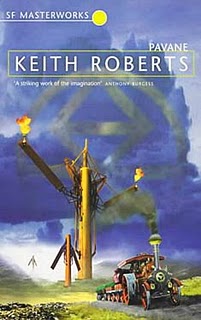
SF Masterworks #35: Keith Roberts, Pavane

On a warm July evening of the year 1588, in the royal palace of Greenwich, London, a woman lay dying, an assassin's bullets lodged in abdomen and chest.  Her face was lined, her teeth blackened, and death lent her no dignity; but her last breath started echoes that ran out to shake a hemisphere.  For the Faery Queen, Elizabeth the First, paramount ruler of England, was no more...

The rage of the English knew no bounds.  A word, a whisper was enough; a half-wit youth, torn by the mob, calling on the blessing of the Pope...The English Catholics, bled white by fines, still mourning the Queen of the Scots, still remembering the gory Rising of the North, were faced with fresh pogroms.  Unwillingly, in self-defence, they took up arms against their countrymen as the flame lit by the Walsingham massacres ran across the land, mingling with the light of warning beacons the sullen glare of the auto-da-fé. (p. vii)

As a historian, particularly one who concentrated on cultural and religious history, I am very wary of any work of alt-history that introduces radical changes from a simple "what if?" scenario.  It is not because I think such speculations are fruitless.  After all, not much would be accomplished in historical studies if such questions were not asked daily of almost everything.  Rather, it is the sense that for many, perhaps for the authors as much as the readers of such alt-histories, there is a distortion that occurs whenever a focus is shifted to a singular person or event.  Unfortunately for me, Larry as Reader, whenever I have to confront these questions of possible historical distortion in a story, Larry as Historian intrudes upon the Reader/Text/Author interpretation triangle, muddying the waters of story analysis.

This certainly was the case with my recent reading of Keith Roberts' 1968 novel, Pavane.  Roberts certainly crafted a stirring beginning, as indicated by the first two paragraphs of his two-page prologue that introduces the vastly-altered 20th century setting.  The year 1588 certainly was a momentous occasion, as some date from it England's rise to international prominence, a position it maintained until the end of World War II.  There certainly were precarious conditions within the country, as Roberts does note, as well as conflicts with Spain and to a lesser extent, France.  But there are a host of other issues, ranging from social divisions that ran deeper than the newly-formed religious factions to the already well-developed sense of English nationalism, that make it difficult for this reader at least to accept that there was a blithe acceptance of the posited Armada conquest and the full and total restoration of the Catholic Church in England.

Sometimes reviewing a work means that the reviewer has to review his or her own biases and attempt to quell them, if they cannot be suspended for the duration of this piece.  For the most part, once I accepted that there was going to be a dissonance between my understanding of history and what Roberts uses as a catalyst for his story, I was resigned to the fact that I would be battling myself in an attempt to enjoy this story and to appreciate what Roberts does accomplish with his six interconnected stories and a brief coda.  Despite my misgivings about the rationale behind such an alt-history and despite my puzzlement over some of the implications of the imagined alt-choices that Roberts highlights, there are things of value within this story.

Most of the action of these stories takes place in the early to mid-20th century.  The Catholic restoration has been in place for nearly four hundred years, not just in England, but also in the formerly Protestant German states.  Technological advancements have mostly been halted, although there are some curious analogues to the Industrial Revolution.  The guild system is still largely intact and the populace has been redivided into ethno-linguistic lines (a restored Norman French, Middle English (!), Modern English, Welsh, Scots, Scottish Gaelic, and Latin are now the languages of Court and People).  There is steam transport, but the use and power of it is heavily regulated.  Learning is concentrated in the hands of the few, and the Papacy has as much influence as in the days of Innocent III.  It is an alien world to us, one that frankly seems unrealistic considering the developments in Catholic countries during the 15th-18th centuries (not to mention that of the Protestant-controlled regions during the same time), but the key to these stories is not to focus so much on the backdrop, but instead on the characters' interactions with this alt-environment.

Roberts' characters shine in the stories contained within this narrative collection.  With very few characters appearing in more than one story, each of the characters that do appear in these stories typically find themselves confronting the world around them, questioning the order of things and in some cases, wondering about these apparently mystical "old ones" that appear on occasion, hinting at a different reality.  Roberts doesn't rush the telling of these stories; he allows the characters to "breathe" and to express their hopes and fears in such a fashion that the reader becomes more drawn to unraveling those little connections between the stories.  The prose is very well-constructed, as few words are wasted and everything builds up to a strong conclusion in the Coda.   If the reader can accept the plausibility of the narrative overarching the individual tales presented within it, Pavane can feel just like the slow, intricately-constructed dance after which the book is named.

But that is the key issue here.  Can the reader suspend his or her disbelief enough to enjoy the rich tapestry of stories?  For myself, I struggled throughout.  I did appreciate how well Roberts constructed his stories; I just could not accept the premise.  Even with the revelations at the end that overturned some of the conceits found within the linked stories, I found myself thinking far too often "this just is not plausible enough!" for me to gain full enjoyment out of it.  However, this is a highly individualized reaction and I could see for those readers who want well-constructed stories with interesting characters and prose that makes their concerns feel vivid and "alive" where Pavane would be just the sort of story for them.  Recognizing that a work may be a "masterwork" does not mean that one has to "like" it, of course.  For me, Pavane was a book whose merits were partially obscured by my own biases and skepticism about the premise behind the stories contained within it.  Those biases and skepticism were never fully overcome, thus lessening my enjoyment, if not my appreciation, for this work.

SF Masterworks #66: Lucius Shepard, Life During Wartime

One of the new Sikorsky gunships, an element of the First Air Cavalry with the words Whispering Death painted on its side, gave Mingolla and Gilbey and Baylor a lift from the Ant Farm to San Francisco de Juticlan, a small town located inside the green zone, which on the latest maps was designated Free Occupied Guatemala.  To the east of this green zone lay an undesignated band of yellow that crossed the country from the Mexican border to the Caribbean.  The Ant Farm was a firebase on the eastern edge of the yellow band, and it was from there that Mingolla - an artillery specialist not yet twenty-one years old - lobbed shells into an area that the maps depicted in black-and-white terrain markings.  And thus it was that he often thought of himself as engaged in a struggle to keep the world safe for primary colors.

Mingolla and his buddies could have taken their R and R in Rio or Caracas, but they had noticed that the men who visited these cities had a tendency to grow careless upon their return; they understood from this that the more exuberant your R and R, the more likely you were to end up a casualty, and so they always opted for the lesser distractions of the Guatemalan towns.  They were not really friends; they had little in common, and under different circumstances they might well have been enemies.  But taking their R and R together had come to be a ritual of survival, and once they had reached the town of their choice, they would go their separate ways and perform further rituals.  Because the three had survived so much already, they believed that if they continued to perform these same rituals they would complete heir tours unscathed.  They had never acknowledged their belief to one another, speaking of it only obliquely - that, too, was part of the ritual - and had this belief been challenged they would have admitted its irrationality; yet they would also have pointed out that the strange character of the war acted to enforce it. (pp. 1-2)

The 1980s were a strange time for the American people.  The country was still smarting over its failures in Vietnam and views of war and its purposes were perhaps the bleakest ever in American history.  Several movies about the Vietnam experience and its effects on the soldiers were made, ranging from anti-war movies such as the Ron Kovacs' autobiographical story, Born on the Fourth of July, to the Rambo movies to the Missing in Action movie series.  There were also TV shows such as The A-Team that referenced the war and the indignities that the returning soldiers experienced obliquely.  During this time, the American government continued to be engaged in covert operations in Central and South America to prop up anti-Communist forces in Chile, Colombia, Nicaragua, and perhaps most tragically, in El Salvador, which suffered from a thirteen year civil war from 1979 to 1992.  Several novels, realist and alt-historical alike, were written about these conflicts and the psychological traumas that they inflicted upon soldiers and civilians alike.  One of the strongest portrayals of this period and its mindset is Lucius Shepard's 1987 classic, Life During Wartime, which combines the psychological elements of Apocalypse Now with a close look at the small-scale wars in Latin America that perhaps can be viewed as the forerunners for today's conflicts.

Above is a quote taken from the book's introduction.  Shepard immediately removes the reader from his or her comfortable setting and places them in the midst of a conflict that has already embittered and stressed the combatants.  Notice how there are only last names given; no first names nor ranks.  There is a sense of superstitious cynicism about Mingolla and his two companions.  They are together only because they are forced together, and yet that force is not anything formal or commanded, but is an ad hoc reaction to what they have witnessed.  Already there are nicknames for locales - the Ant Farm could as well be Hamburger hill - and there is a tension present, as if at any moment the soldiers might snap.  Shepard sets the stage here for an insightful look at brutality, but he takes it further than what a contemporary war novelist might have written.

Mingolla, whose pre-war life is barely touched upon (he was a high school athlete who entered the military after graduating from high school) except to provide contrasts for his future development, is soon tested for an experimental new army group, the PsiCorps, a group of soldiers who, with the right drugs and training, are able to use their minds to influence thoughts and actions of those who are not gifted with this ability.  As seen in one early scene, this power disconcerts him:

The Cuban eased toward Mingolla's door, his progress tangible, like a burning match moving behind a sheet of paper.  Mingolla's calm was shattered.  The man's heat, his fleshy temperature, was what disturbed him.  He had imagined himself killing with a cinematic swiftness and lack of mess; now he thought of hogs being butchered and pile drivers smashing the skulls of cows.  And could he trust this freakish form of perception?  What if he couldn't?  What if he stabbed too late?  Too soon?  Then the hot, alive thing was almost at the door, and having no choice, Mingolla timed his attack to its movement,s stabbing just as the Cuban entered.

He executed perfectly. (p. 52)

Shepard's use of limited third-person perspective to show just what was happening to Mingolla during his development is superb.  Mingolla's thoughts, his reactions, all of this feels "natural" and not too rushed or too explicit.  Shepard integrates well the psychic training that Mingolla has received with the harsh brutality of the Guatemalan jungle warfare that is occurring between the American-led forces and the Cuban/Communist opponents.  But before the reader begins to think that this will settle into a sort of psychic/psychological game of cat-and-mouse, Shepard introduces a wild card:  the mysterious woman named Deborah, who may be a spy for the Sombra group, the counterparts to PsiCorps.  Shepard easily could have made Deborah into a sort of Bond seductress, but in one key scene about halfway into the novel, he shows the other side of the conflicts that Mingolla and others have been experiencing during the jungle campaign, one that is at least as brutal as anything the soldiers have undergone:

"Maybe I should tell," she said.  "Maybe it'll explain why I was so reticent with you at first."

"Back in Emerald?"

"Yes...you see there were a lot of reasons I didn't want to get involved with you like this, and one was I was afraid it wouldn't be any good between us."

"You mean sex?"

She nodded.  "It hadn't ever been good for me, and I thought nothing could change that, not even being in love.  But it is good, and I keep getting scared it won't last."

"Why?"

"Because it's so perfect...the way you fit me, how you touch me.  And everything before was so imperfect."  She turned away as if embarrassed.  "When they brought us in for interrogation...the government..."

"Your family?"

"Yes.  She let out a sigh.  "Why they brought us in, I knew they'd rape me.  That's what they always do.  I prepared for it, and every day that passed, every day it didn't happen.  I grew more afraid.  I thought they must be saving me for something special, some special horror."  (p. 266)
Rather than just simply continued, tortuous rape, the Communist regime has something even more nefarious in mind with this delay and the subsequent raising of hope:

"I was beginning to think the major just wanted me to sit there and look nice.  Then about two o'clock he came to his door and said, 'Debora, I need you now.'  Just the way he'd ask a secretary in to take dictation, just that offhanded tone.  I went into the office, and he told me to take off my underwear.  Still very polite.  Smiling.  I was afraid, but like I said, I'd prepared for this, and so I did what he asked.  He told me to get down on my hands and knees beside the desk.  I did that, too.  I shed a few tears, i remember, but I managed to stop them.  He pulled out a tube from his drawer, some kind of jelly, and...and he lubricated me.  That was almost the worst part.  And then he dropped his trousers and came inside me from behind, the way you..."

"I'm sorry;" said Mingola.  "I didn't..."

"No, no!"  Debora's hands fluttered in the dark, found his face, cupped it.  "Sometimes I wanted you to do that, but..."  She sighed again. (p. 267)

Shepard manages to navigate between the treacheries of being too casual with such a scene and overplaying the brutality of the repeated rapes Debora had to endure before she would accept her training as a psychic agent.  Debora's inhumane treatment, underscored by the sheer callousness of the major's hum-drum approach to degrading her by utilizing sex as just another manipulative tool, contrasts nicely with the character development of Mingolla and certain other characters in the first half or so of the novel.  These vivid scenes serve not just to develop the mood, but to further the plot, until the narrative tensions builds to a crescendo that comes crashing down in a finale that lives up to the promise of the slow psychological buildup.

Life During Wartime is one of the best psychological SF stories that I have read.  Shepard's prose is outstanding through.  His characters feel "real" and their traumas, subtle and obvious alike, are woven into a taut plot that furthers its thematic exploration of war and the traumas inflicted by it.  There are very few weak points to discuss, if any.  Perhaps a character's arc could have been furthered a slight bit further, but it would be at best quibbling over what really is an outstanding work of fiction.  Highly recommended.

SF Masterworks #21: Olaf Stapledon, Star Maker

In a study of Poe's Eureka, Valéry has observed that cosmogony is the most ancient of the literary genres; despite the anticipations of Bacon, whose New Atlantis was published at the beginning of the seventeenth century, it is possible to confirm that the most modern is the fable or fantasy of scientific character.  It is known that Poe approached the two genres separately and perhaps invented the last one; Olaf Stapledon combined the two in this singular book.  For this imaginary exploration of time and space, he did not resort to vague troublesome mechanisms, but instead to the fusion of a human mind with others, to a kind of lucid ecstasy or (if one wants) a variation of a certain famous Cabalistic doctrine, which supposes that in the body of a man can inhabit many souls, as in the body of a woman about to be a mother.  The majority of Stapledon's colleagues seem arbitrary or irresponsible; this work, in exchange, leaves the impression of sincerity, despite the singular and at times monstrous nature of his stories.  He doesn't accumulate inventions for the distraction or stultification of those who will read him; it follows and it registers with honest rigor the complex and shady vicissitudes of a coherent dream. (Jorge Luis Borges, Prólogos con un prólogo de prólogos, p. 232)

Borges' commentary on Olaf Stapledon's 1937 novel, Star Maker, serves as a perfect introduction to this work that builds upon and expands the scope found in his earlier 1930 novel, Last and First Men.  In my review of that earlier book, I focused on the cyclical nature of the narrative as two billion imagined years of future human existence were outlined.  Here in Star Maker, Stapledon expands that narrative in two ways.  The first is simply a matter of magnitude, instead of a measly two billion years, he charts a course through innumerable epochs of stars, galaxies, and the life that sometimes sprung up out of dead stellar material.  The second is more tricky.  As Borges notes in the excerpt I translated above, there is a sort of union of souls, as the human narrator at the beginning of the novel finds himself disassociated from his body, which in turn permits him to touch upon what may be the ultimate cosmic mind, the Star Maker himself.

Due to the presence of this disembodied human observer, the narrative structure for Star Maker oddly enough feels less "distant" than that of Last and First Men, despite the tens of billions more years covered in this book compared to the other.  Although the narrator is mostly content to make observations about the various strange (and sometimes familiar) life forms he encounters on his psychic journey through space-time, there are times that his observations serve to create a sort of quasi-mystical connection between various lifeforms and their struggles to understand that central mystery of "what is life and why am I alive to ask this question?"  Take for instance this passage about a race of plant-men:

It was of course through animal prowess and practical human intelligence that the species had long ago come to dominate its word.  But at all times this practical will had been tempered and enriched by a kind of experience which among men is very rare.  Every day, throughout the ages, these beings had surrendered their feverish animal nature not merely to unconscious or dream-racked sleep, such as animals know, but to the special kind of awareness which (we learned) belongs to plants.  Spreading their leaves, they had absorbed directly the essential elixir of life which animals receive only at second hand in the mangled flesh of their prey.  Thus they seemingly maintained immediate physical contact with the source of all cosmical being.  And this state, though physical, was also in some sense spiritual.  It had a far-reaching effect on all their conduct.  If theological language were acceptable, it might well be called a spiritual contact with God.  During the busy night-time they went about their affairs as insulated individuals, having no present immediate experience of their underlying unity; but normally they were always preserved from the worst excesses of individualism by memory of their day-time life. (p. 118)

Although there was some hint of this metaphysical concern in Last and First Men, it is here in Star Maker where Stapledon unfolds his narrative further to incorporate speculations on "meanings" and "purposes" for life and the cosmos.  While much of Stapledon's writings show at least some influence from authors like Schopenhauer and Spengler, the structure of Stapledon's narrative here (as it was to a lesser extent in Last and First Men) is that of a Marxist character, especially with its focus on societal mechanisms of thesis-antithesis-synthesis.  However, Stapledon added a few quasi-religious undertones to this narrative (as the above quote hints at) that likely confounded the more orthodox Marxist readers of this text.  In speculating on a divine figure, Stapledon is not demonstrating any loyalty to a particular creed; if anything, his Star Maker is a troubling entity, unconcerned as it seems to be, at least at first, with the organisms, ranging from galaxies to microbes, that it creates in order to destroy, perhaps in order to learn how to perfect what it has created.

This is not a comforting element.  It can be downright disturbing to imagine.  Yet Stapledon manages to create a sprawling narrative around this Star Maker (as witnessed in glimpses by the disembodied narrator) that somehow manages to be less threatening than it otherwise may have been.  Perhaps it is the Star Maker's quest for perfection reminds us of our own all-too-human desire to improve and expand our horizons and accomplishments that makes at least one facet of its immense personality fathomable to us.  Star Maker is not as much a novel about the universe as it is a microcosm in print form for all of our hopes and dreams regarding where we came from and where we're heading.  As such, it is a fitting sequel to Last and First Men and its sometimes-inconclusive responses to core human concerns makes it a "masterwork" worthy of reading by people from all walks of life even after seventy-plus years since its initial publication.